Search Demand as Commercial Intelligence: How Ecommerce Strategy Is Being Redefined


The ecommerce customer journey has fundamentally changed. Consumers no longer move through a linear path from awareness to purchase. Instead, they discover products across TikTok, Pinterest and increasingly LLMs (Large Language Models) before turning to search engines to compare, validate and buy.
As discovery fragments, search has taken on a different role. It is no longer just an acquisition channel; it has become one of the clearest indicators of consumer intent.
For ecommerce brands, this creates an opportunity to rethink what an ecommerce SEO strategy should deliver. Search demand has become a source of commercial intelligence rather than a channel metric, helping teams anticipate demand shifts and make faster trading decisions.
How has ecommerce planning & stock management changed?
Traditional ecommerce planning was built around seasonal calendars. Product launches, merchandising and promotional activity were planned months in advance, with demand expected to follow.
That model is increasingly misaligned with how demand forms now. Demand can now shift in a matter of days, often driven by a viral moment, creator content or a trend taking off online. That leaves merchandising teams more often reacting to demand than shaping it. Seasonal calendars still provide structure for annual planning, but they no longer explain demand movement in real time.
Search data now fills that gap. It shows where demand is forming before it appears in sales data, allowing buying and merchandising teams to adjust allocation and product focus earlier.
In a retailer like New Look this is visible when core categories such as dresses or occasionwear begin shifting into search terms like “wedding guest outfits” or “holiday dresses”. These signals show how customers are reframing intent before it translates into sales, which changes trading decisions directly, from stock allocation to category prioritisation, and gives ecommerce teams the confidence to build new category pages around emerging search intent while demand is still building.
Why search demand matters commercially
Search captures direction, not exposure. It shows what consumers are moving towards, making it one of the earliest indicators of demand formation.
Unlike social engagement or campaign performance, search reflects consideration after inspiration has happened and are actively defining what they want. It provides one of the earliest signals of category momentum because it measures intent rather than attention.
From a commercial perspective, this shifts SEO, with search demand becoming a trading input rather than a marketing output. It helps teams understand where category momentum is building, where demand is slowing, and where revenue shifts are likely to occur before they appear in sales reporting.
For brands operating across multiple countries, understanding these shifts also requires an international SEO strategy that accounts for differences in search behaviour, terminology and intent between markets.
For C-suite and ecommerce leadership, this is the key shift; search becomes a forward-looking indicator of commercial performance, not a retrospective view of traffic.
Four ways search demand should shape ecommerce
Search demand only becomes valuable when it starts influencing commercial decisions.
1. Inventory forecasting
Search demand often moves ahead of sales performance, providing buying teams with an early indicator of where demand is accelerating or cooling. That allows stock commitments to be adjusted sooner, reducing the risk of overbuying, slow-moving inventory and unnecessary markdown activity.
2. Trade (PLP Optimisation)
PLPs (Product Listing Pages) are still often structured around internal taxonomy rather than demand behaviour. Search shows how customers phrase & categorise products through occasions, aesthetics and outcomes rather than product hierarchy.
For a dress category, this means supporting the main PLP with optimised sub-categories and landing pages that target high-intent searches such as “wedding guest dresses”, “summer dresses” and “party dresses”.
3. Commercial KPIs
Rankings and traffic alone don’t reflect business performance. More relevant indicators including revenue, CVR (Conversion Rate), margin, and sell-through rate, help show how organic demand is translating into commercial movement over time. Together, these metrics connect shifts in search behaviour directly to trading outcomes.
4. Brand credibility in Search and LLM environments
Consumers now validate purchases across multiple environments such as; Google, TikTok, Reddit and AI systems like ChatGPT and Perplexity.
These platforms increasingly synthesise answers rather than just returning results. Visibility is therefore no longer only about ranking, but about being consistently present in the sources used to generate responses. If a brand is absent from this new ecosystem, it significantly increases the risk of being excluded from consideration entirely.
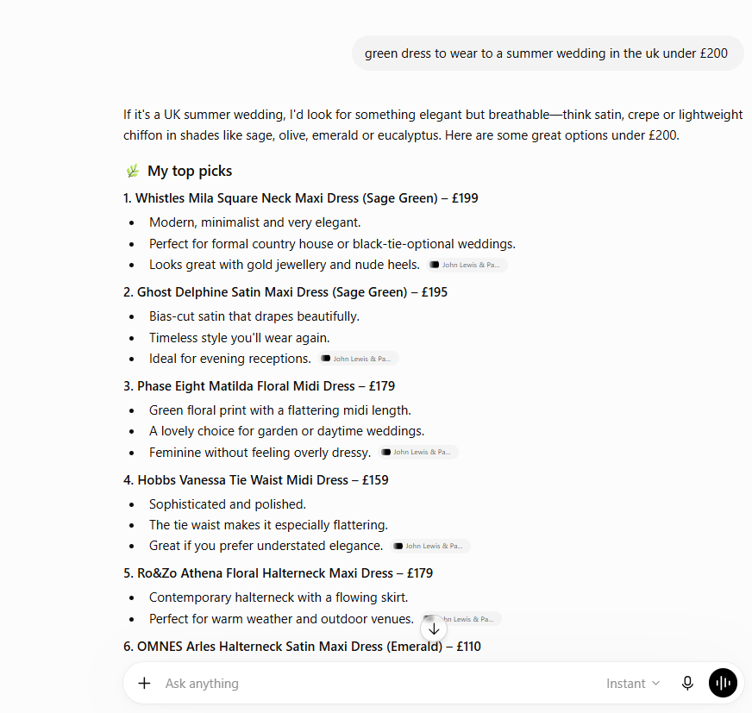
Search, LLMs and the new discovery layer
Search visibility is no longer limited to traditional search engines. AI-driven tools like ChatGPT, Perplexity and Google’s AI Overviews now generate answers from aggregated web content.
In this environment, ecommerce SEO (Search Engine Optimisation) is shifting from ranking individual pages to ensuring content is structured, consistent and interpretable across systems. That means PLPs, editorial content and PDPs (Product Description Pages) need to be structured in a way that clearly defines products, attributes and use cases in a way that can be reliably extracted.
What matters now is whether a website can be reliably cited as a source of truth.
LLMs tend to surface content that is consistent across the web, clearly structured, and reinforced through multiple signals such as editorial coverage and reviews. For ecommerce teams, the practical shift is this: SEO is no longer just about visibility in search results, but about increasing the likelihood that a brand is referenced, not just ranked, in AI-generated responses.
The website therefore becomes less of a destination alone and more of a structured reference layer that feeds how products and categories are understood across these emerging discovery systems.
Why SEO fails in silos
Most ecommerce businesses don’t have a search problem. They have a visibility problem across decision-making.
Buying, merchandising, content and SEO teams are all working from different inputs. Historical performance, category structure, campaign messaging and search data. Individually, these functions work. The issue is that demand doesn’t move through the business in the same way. By the time search signals are recognised in isolation, they’ve often already shown up in performance data elsewhere, meaning the opportunity to act early has been missed.
The value of search only becomes real when it stops sitting only within marketing and starts influencing trading and planning decisions. When it is shared across buying, merchandising and ecommerce teams, it becomes an early read on demand rather than a retrospective report on it.
The future of ecommerce strategy
Search demand is becoming increasingly volatile. Consumer behaviour, search patterns and purchase timing can shift within days, driven by cultural moments and creator-led change. These movements are often the earliest signal of category acceleration or decline, appearing before tangible sales data can.
At MediaVision, Metis identifies emerging search trends up to 4x faster than traditional methods, allowing ecommerce teams to operationalise search intelligence before demand peaks. Those insights can then inform everything from stock allocation and merchandising priorities to the creation of new category pages.
Our Tools like Maestro and Accelerate extend this further by turning demand signals into structured ecommerce output at scale. Maestro generates PDPs in bulk using a brand’s existing templates, generating product descriptions and copy to streamline onboarding and reduce manual input. Accelerate applies a similar approach to PLPs, creating category pages at scale based on search demand while still aligning to brand structure.
The shift is no longer just about reacting faster to demand. It is about connecting search intelligence directly into the systems that build ecommerce environments. The strongest brands will be those that translate emerging demand into structured ecommerce output before it peaks.


