How to Prevent PPC from Cannibalising SEO Efforts


One of the most common inefficiencies in search marketing is paying for traffic you already own. PPC cannibalisation occurs when paid ads capture clicks that your organic listings would have won anyway, meaning you’re paying for traffic you already earned through SEO. This leads to inflated PPC numbers, reduced organic numbers and wasted spend for a business.
This is where the conversation needs to shift. It’s not about whether PPC and SEO overlap, because they often will. It’s about whether that overlap is incremental or redundant, and whether your investment is generating new demand or simply redistributing existing traffic. Utilising paid ads on terms you already hold the top organic spot for isn’t inherently wrong, and this largely depends on what the search engine results page looks like in practice.
Why the competitive landscape matters more than ranking position
A common mistake is treating organic ranking position as the key decision factor in using ads. What matters more is the composition of the SERP. On low competition queries, where ads are minimal and organic listings dominate, SEO can carry most demand capture. In these cases, heavy PPC investment often adds limited incremental value. You may still see conversions attributed to paid, but total performance rarely shifts when ads are removed.
In more competitive environments, incrementality testing can play a key role to uncover the most effective total search strategy. Similar keywords can be highly incremental in one SERP and largely redundant in another. Understanding that context is critical to making the right investment decisions.
Another note on landscape is volatility; these landscapes change and it’s important to consider re-visiting tests and keep an eye on the type of SERP appearing for key queries.
Should you bid on keywords you already rank for?
There is no simple yes or no here, but there are some guidelines to consider:
If your organic visibility is limited through paid competition, SERP features or reduced click-through rates, then an incrementality test with PPC is worth considering. In this case, paid search ads may help with reclaiming visibility, controlling messaging and capturing demand more effectively.
If, however, you dominate the page organically and competition is low, then paid activity is less likely to generate new clicks. In these situations, it often functions as a redistribution mechanism rather than a growth driver.
When it comes to paid ads, an important consideration is your Return on Investment (ROI). Using Metis Total Search, we can see exactly how your paid search spend is performing at a keyword level.
Even if your ads are appearing more often and getting clicks, a low ROI is a red flag that you might be wasting budget. At this point, you have a choice: is the extra brand awareness worth the cost? If your primary goal is to dominate the search results and keep your brand front-of-mind, a lower ROI might be acceptable. However, if your ads are strictly there to drive sales, a negative ROI is a clear sign that something isn’t working. In those cases, it’s usually best to pause the ad and rethink your approach.
The key question to ask is straightforward: what happens if you stop? If overall traffic and revenue remain stable, the activity wasn’t incremental. If they drop, it’s doing real work.
Not all PPC is created equal
Another layer of nuance comes from the type of paid ads you’re running. Search ads are the most directly comparable to organic listings, which is why they carry the highest risk of cannibalisation. They target the same queries, often drive to the same pages, and compete for the same user attention.
Shopping ads behave differently. Their visual format, including pricing and imagery, draws engagement in a way that organic listings typically don’t. As a result, they often generate additional demand rather than replacing it, particularly in ecommerce. Even when a product ranks well organically, a strong presence in the shopping grid can lift total click volume.
AI-driven formats such as Performance Max complicate this further. By blending multiple channels and automating targeting, they can deliver strong reported performance while making it harder to distinguish between incremental and existing demand. Without a clear view across SEO and PPC, it’s easy to overestimate their true impact.
AI has changed the dynamics of search
The rise of AI in search has accelerated many of these challenges. SERPs are becoming increasingly fragmented, with AI-generated answers, expanded features and reduced clicks on organic listings.
The result is a shift in how the channels interact. SEO is evolving towards demand generation and brand influence, while PPC is focused on demand capture. The overlap still exists, but both channels are now working within a more constrained and competitive environment.
Brand vs non-brand: where inefficiency creeps in
If you’re trying to identify cannibalisation, brand search (searches including your brand’s name) is the most obvious place to start. It’s also where the biggest inefficiencies tend to sit. Brand queries are typically searched by users with high intent to find that specific site.
Users likely already know who they’re searching for, and if you rank first organically, you’re well positioned to capture that traffic without needing paid support. The moment you layer PPC activity on top, there’s a risk you’re simply paying to intercept demand you’ve already created.
That doesn’t mean brand bidding is always unnecessary. In competitive environments, it plays an important defensive role. Certain brands may find competitors bidding on their name, which would lead to a risk of a competitor appearing in the paid search spot above the organic results. In these cases, utilising paid search ads can be justified to defensively protect your share of voice for your own SERP. This is even more important when the SERP is also showcasing other features on the results page (such as shopping listings). The more features on the SERP, the increased pixel depth to the first organic result. Depending on screen size, device and resolution, this can lead to a much deeper organic listing and even in the number 1 position may see a significantly reduced CTR (click-through rate).
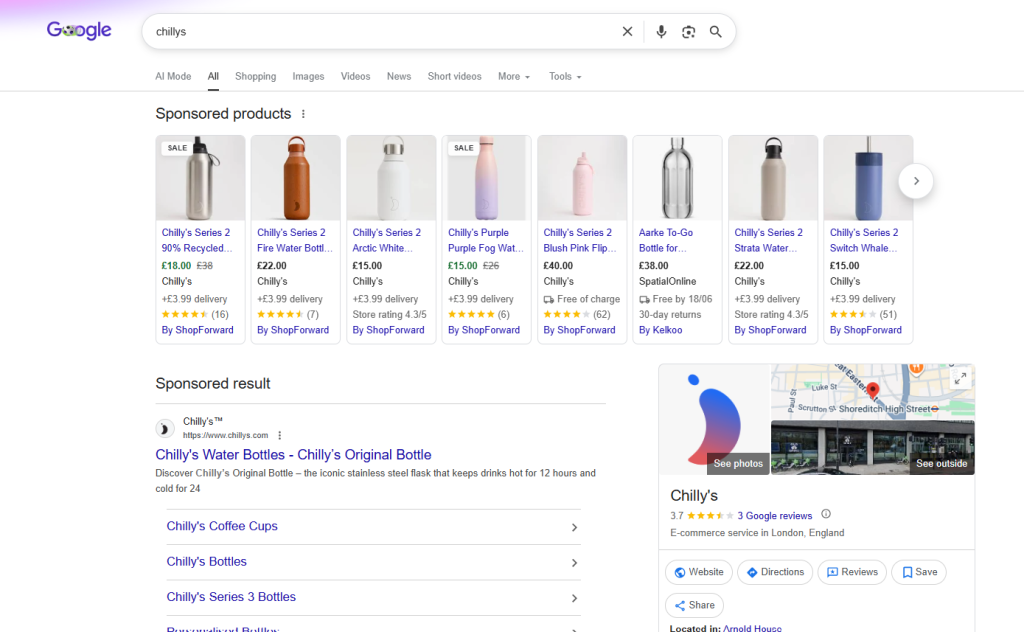
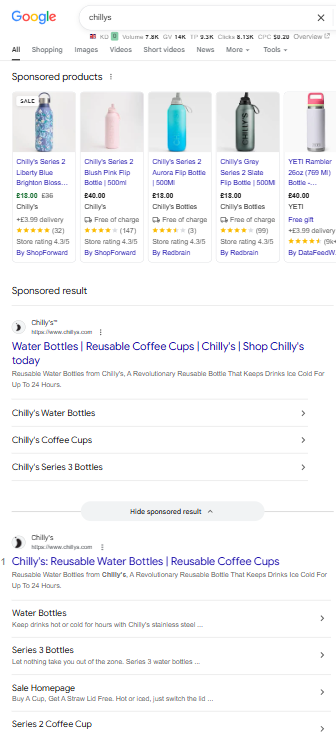
Example of a SERP (Search Engine Results Page) for Chillys on desktop and mobile.
With the increased prevalence of AI overviews on SERPs, the pixel depth for organic listings often is pushed even lower, further impacting the organic CTR.
Where brands lose efficiency is treating brand PPC as a constant rather than a variable. When the competitive spend disappears, maintaining high spend often results in the same level of traffic, but includes unnecessary cost. The clicks don’t increase; they just move channels. This is why monitoring the competitive landscape (particularly for branded terms) is highly important for brands; to maintain SOV when competitors are bidding, and to save the spend when they are not.
Metis Total Search highlights these opportunities monthly, pulling in metrics across paid and organic to identify the terms with:
- Strong organic positioning
- Paid search ad spend
- Sub-1 Return on Investment (ROI)
By utilising these recommendations, Metis users have been able to save £000’s each month to combat keyword cannibalisation.
Non-brand: Search cannibalisation
Cannibalisation on non-brand terms occurs when PPC isn’t filling gaps but duplicating them. Non-brand searches are typically more competitive than branded search and is often more likely to feature paid features on the SERP. If you’re in a strong organic position for a set of non-brand terms and then start bidding aggressively without testing the impact, there’s a strong chance you’re paying for traffic you would have received anyway.
This is where incrementality testing becomes an important process to implement.
Measuring incrementality in practice
To move beyond assumptions, you need a way to measure whether PPC is adding value. Standard reporting won’t give you the answer, because it looks at channels in isolation rather than total performance.
A more effective approach is to build a simple, shared view of SEO and PPC data at a page or query level. It is generally easier to do this at a page level as the comparison will be more like-for-like (due to the possibility of traffic spreading across pages for the same query, or multiple query variants that would also need to be controlled). By combining both datasets for a defined group of core pages, you can track total clicks, impressions, conversions and revenue over time. This becomes your test group. For Organic data, it is important to utilise data from both Google Search Console (Clicks, Impressions, Avg position) as well as Google Analytics (transactions, events, revenue, etc) to have the best context available for data comparisons. Alongside this, you create a control group, either a comparable set of pages or regions where paid activity remains unchanged.
Timelines can vary, but we recommend both the test and control groups measured 2 weeks pre-test, 2 weeks during test and 2 weeks post-test, with each 2-week period also showing a previous year number. This allows any increases that may be due to seasonal shifts to be identified more easily. Structuring this in a straightforward spreadsheet, with separate tabs for test and control, allows you to see whether reducing or removing PPC has a meaningful impact on overall performance.
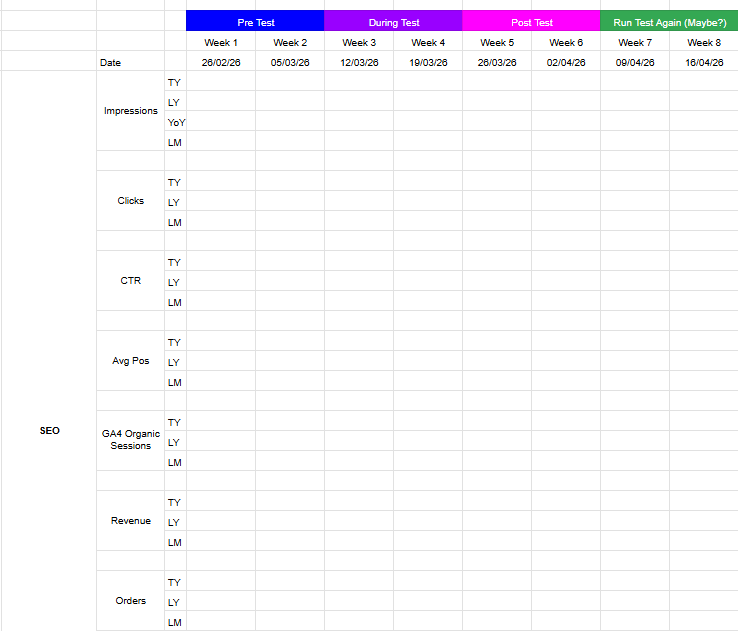
This type of sheet doesn’t need to be complex to be effective – the simplicity is what makes it scalable. With the right structure, it can easily be turned into a repeatable template that teams use across campaigns to identify where spend is truly driving incremental revenue.
Once you start looking at combined performance rather than individual channels, patterns become much clearer. If total clicks and conversions remain stable when PPC is reduced, then the investment wasn’t generating new demand. If performance declines, then it’s contributing incremental value.
This process can and should then be repeated for various keyword sets/ pages to optimise the total search strategy across a range of market environments.
Scaling insight with Metis Total Search
As activity and workload grow, running these tests manually across every keyword or page becomes significantly harder. This is where a Total Search approach becomes increasingly important.
By bringing SEO and PPC data together into a single view, Metis allows brands to move beyond siloed reporting and start understanding how channels interact in practice. Rather than guessing where cannibalisation might exist, you can identify where spend overlaps with strong organic performance, where share of voice is being defended effectively, and where there are clear opportunities for incremental growth.
This kind of visibility also changes how success is measured. Instead of focusing purely on channel-level metrics, you can assess performance in terms of overall efficiency, contribution to revenue, and share of model across search as a whole.
Final thoughts
PPC cannibalisation isn’t about one channel taking from another. It’s about whether your investment is driving additional value or simply reallocating what you already have. For most brands, the issue isn’t a lack of performance, it’s a lack of clarity. Without a unified view of SEO and PPC, it’s easy to continue investing in areas that feel safe, particularly brand search, without understanding their true impact.
The opportunity lies in shifting the mindset. When you focus on incrementality rather than attribution, you start to see where PPC genuinely supports SEO, where it simply duplicates effort, and where it can unlock new growth altogether.
If you want to hear how we can support your Total search strategy and optimise your ad spend, get in touch.


