How AI is Rewriting the Rules of Ecommerce SEO


Ecommerce SEO is experiencing a tectonic shift. We’ve long moved past the era where SEO was simply about ranking blue links on a results page. Today it’s all about ‘search everywhere optimisation’ where brands seeking true visibility have to optimise across a variety of platforms – including AI models that don’t just point to products, they research, recommend, and even purchase them.
For retailers, this evolution presents a unique paradox and friction point: AI offers unprecedented efficiency, yet the bar for organic visibility has never been higher. To thrive, brands must look beyond keywords and address the structural and strategic gaps that AI has introduced.
1. Agentic AI: Moving from Searcher to Buyer
Following OpenAI’s rollback of Instant Checkout, many were quick to write off agentic commerce as a fad, with the belief that most people would use LLMs purely for research and would still buy through traditional methods. Whilst that may be the case at the moment, with Google’s Universal Commerce Protocol (UCP) rolling out in shopping results and payment providers like Stripe and American Express building infrastructure for agentic payments, it is clear this new world is coming thick and fast.
In this model, the “user” is often an AI agent acting on behalf of a human. These agents monitor price drops, check real-time availability, and compare technical specs across thousands of SKUs in seconds.
- The Impact: If an AI agent doesn’t “see” your product or trust your data, you are invisible to the consumer as traditional patterns of awareness, consideration and conversion will take place via the agent. Furthermore, with transactions often taking place within Google or other offsite ecosystems, traditional SEO measures of web traffic and conversions become more blurred and difficult to attribute.
2. The Data Gap: Feed the Machine or Starve
When trying to win in this new world, one of the biggest hurdles for modern ecommerce SEO is the data gap. AI models are only as good as the information they can ingest. Many retailers provide “thin” data in product feeds or Schema markup, leaving the LLM in the dark on key details.
To bridge this gap, technical SEO must prioritise:
- Granular Attribute Mapping: It is no longer enough to list “Blue Dress.” You need to provide data on fabric weight, sustainable sourcing, neckline type, and occasion suitability.
- Real-Time Accuracy: Agentic AI relies on precision. If an AI agent recommends a product that is out of stock when the user goes to buy, that brand loses “trust” in the model’s future recommendations.
3. The Long-Tail Challenge on Site
Historically, SEOs targeted “long-tail” terms (e.g., “sage green midi dresses for summer weddings”) by creating specific landing pages. However, as search becomes more conversational, users are typing highly specific, multi-layered queries into AI interfaces rather than traditional search bars.
Because AI synthesises answers from multiple sources, it is becoming increasingly difficult to capture this traffic on your own site. The AI provides the answer directly, often bypassing your long-tail blog posts or category pages. The strategy must shift from capturing the long-tail search to being the authoritative source the AI cites when it answers those complex questions.
In this landscape, external reputation management and social proof is more important than ever. Building natural, unfiltered conversations around your products and services through reviews and other external sources is crucial for curating a citable, AI-ready brand.

A popular example of this is Adidas’ Reddit Ask Me Anything strategy. With Reddit being cited in as many as 11% of LLM answers (Semrush), building conversations within this forum is incredibly fruitful for appearing in conversational answer engines. Adidas’ strategy here was a winner because it created an authoritative piece of content around a growing trend within an external, unfiltered forum, allowing them to build a social conversation around their products and brand with members of their target audience.
4. EEAT in the Age of Infinite Content
The above example is a great case of producing unique, authoritative content with a modern twist. With the ability for anyone to generate thousands of blog posts, category copy and product descriptions in seconds using LLMs, “content” has become a commodity. This has made Google’s E-E-A-T (Experience, Expertise, Authoritativeness, and Trustworthiness) standards the ultimate differentiator.
This is nothing new, however the bar for creating truly unique, helpful content is now higher than ever. To stand out, your content must provide original insights that an AI cannot simply scrape from elsewhere.
- Human Expertise: Incorporate real reviews, expert buyer guides, and first-hand testing videos.
- Helpfulness Over Keywords: AI search filters for “helpfulness.” Content that genuinely solves a user’s problem, rather than just repeating keywords.
A LinkedIn post by Mark Williams-Cook highlighted the difference between helpful content and commodity content really well.
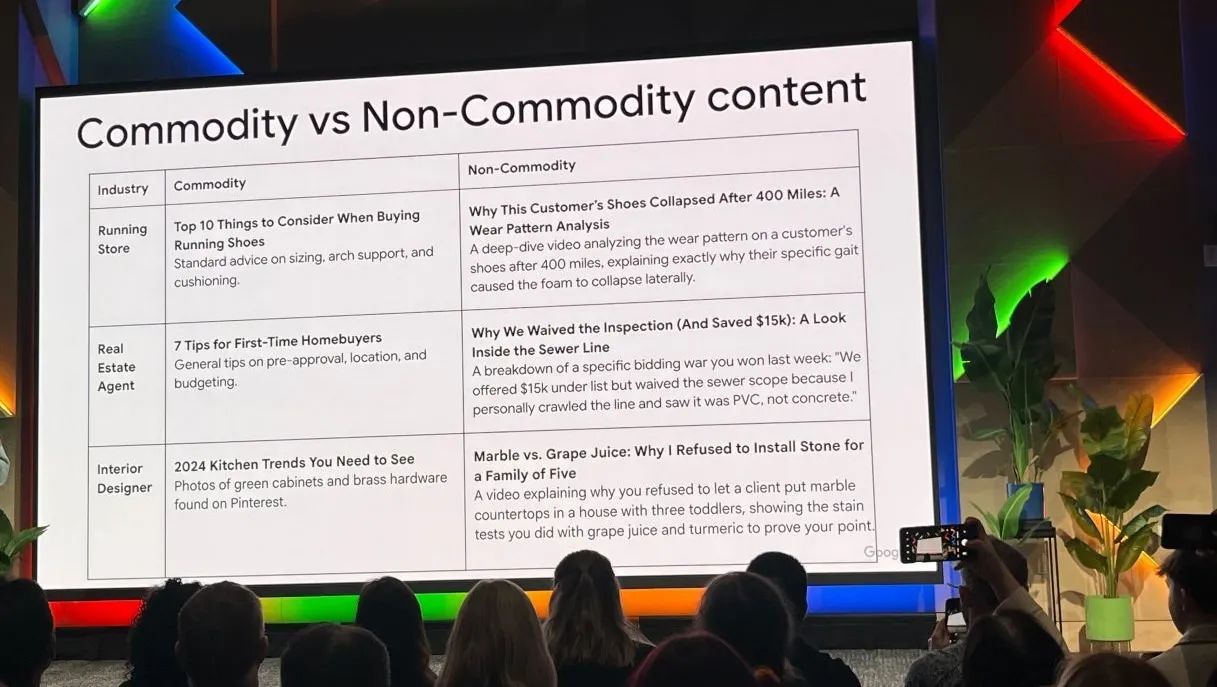
Whilst this long-term approach will cause groans from AI-adopters who want to mass produce content at scale, it is infinitely more beneficial (and more citable) to add genuine value based on expert opinion or lived experience with your content strategy.
As for product descriptions, retailers with a significant SKU count will have no choice but to embrace AI, as the scale of production is too great for most teams to manage alone. However, this is where human-in-the-loop is crucial for managing the output of AI tools and preventing the proliferation of AI-slop. At Metis, we’ve built our Product Maestro solution to provide a solution to this – allowing teams to generate AI-enhanced product copy based on imagery and attribute data, combined with real-time search data from our core Metis Demand Tracker engine. This produces and regularly updates product copy based on trending long-tail keywords that humans actually search for and matches your brand tone of voice to create content that accurately represents your brand and is helpful to users.
5. Measuring Success / ROI in a “Zero-Click” World
One of, if not the most, significant pain point for eCommerce SEOs today is measurement. AI search has brought SEO into the boardroom, with more business executives and leaders interested in how to win in this area. Whilst this is great for the industry, it brings with it a core challenge of how to measure ROI of AI-driven tactics and strategies.
- The Attribution Problem: If a user asks Gemini for a product recommendation and the AI summarises your product’s benefits without a direct link, how do you measure that “impression”?
- Share of Model (SoM): We are moving toward a world where we must measure how often a brand is mentioned in AI prompts versus its competitors, which is a much harder metric to track than a standard SERP position.
Many ‘tools’ offer solutions to this, but work purely by spamming LLMs with prompts which is neither accurate nor environmentally responsible. The truth of the matter is that we are still a long way away from accurate LLM visibility tracking.
Agentic brings in another level to this. If UCP uses mandates to decide how and when agents would make a purchase, how do you attribute that purchase?
The Path Forward
The future of ecommerce SEO isn’t about “gaming” the algorithm; it’s about becoming a trusted partner for AI. And with AI retrieving its source material from the broader internet, your strong traditional SEO strategy will only continue to bear fruit. For retailers operating across multiple markets, a strong international SEO strategy is also essential, accounting for local search behaviour, language and technical requirements in each region.
To go further, ensure you’re closing any data gaps, embracing agentic commerce, and doubling down on human-led expertise. By doing this, retailers can ensure they aren’t just ranked, but recommended.
The transition may feel complex, but the goal remains the same: getting the right product in front of the right person at the exact moment they need it. The engines have changed, but the value of a trusted brand has never been greater.
If you’re a brand interested in organic ecommerce and the impact of AI on retail, feel free to get in touch with us. We’d love to have a chat.


